
FNIRSI DSO152 Handheld Oscilloscope
4.4Editor score
Ultra compact and portable design
Affordable price for beginners
Built-in battery for field use
Digital oscilloscopes are essential tools for visualizing electrical signals. They allow users to measure voltage over time, detect noise, and debug complex circuits. Choosing the right model depends on bandwidth, channel count, and specific features like decode or waveform generation.
We evaluated ten leading digital oscilloscope models based on real-world performance and user feedback. Our analysis covers sampling rates, memory depth, display quality, and connectivity options. This ensures you get a comprehensive view of what each device offers for your testing needs.
Each pick highlights key strengths and ideal use cases. Whether you need a portable unit for field work or a high-end scope for advanced debugging, this list provides clarity. Keep in mind that prices change frequently, so check current listings before purchasing.
4.4Editor score

4.5Editor score
4.3Editor score
As an Amazon Associate we earn from qualifying purchases.
This table offers a side-by-side view of the most popular digital oscilloscope models available today. We compare key specifications like bandwidth, sampling rate, and memory depth so you can quickly identify the model that fits your technical requirements and budget constraints.


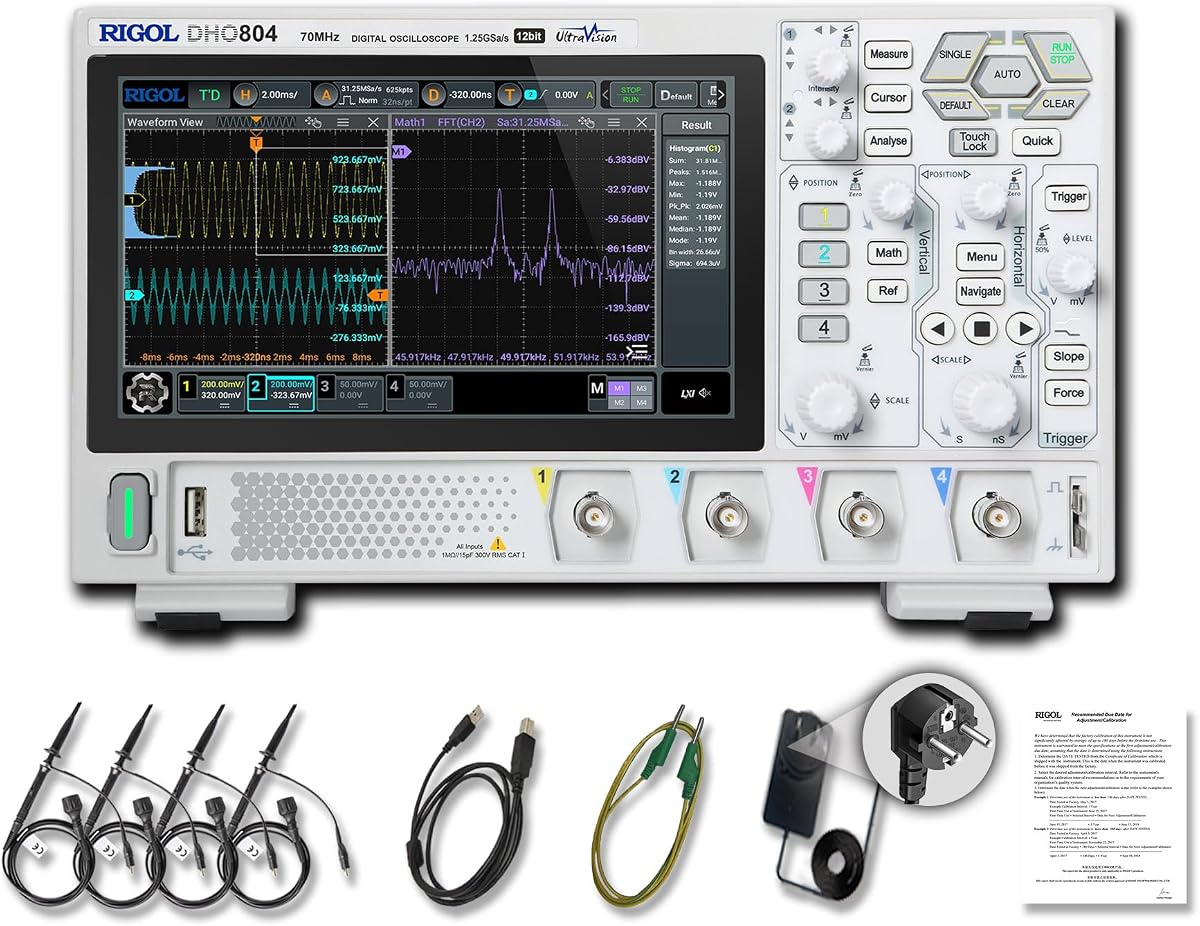
The RIGOL DHO804 stands out as a powerful portable digital oscilloscope ideal for serious debugging. With a 70MHz bandwidth and 4 analog channels, it handles complex circuits with ease. Its 12-bit resolution provides detailed voltage insight often missing in cheaper models.
We may earn a commission when you buy through this link, at no additional cost to you.
Key strengths include the UltraAcquire technology which captures glitches at incredible speeds. This makes finding intermittent issues much easier. The device also supports a wide range of serial protocols like I2C and SPI, streamlining embedded system validation significantly.
While the price is higher than entry-level scopes, the precision and memory depth justify the cost. It offers a 25 Mpts memory depth allowing long captures without losing sample rate. This balance makes it a top choice for engineers needing reliability.
If you need a versatile tool for power ripple checks or sensor validation, this unit delivers. It supports SCPI commands and remote control via LAN. For those prioritizing signal integrity and detailed analysis, this is a strong recommendation for any lab.
Higher vertical resolution lets you see small voltage changes that standard 8-bit scopes miss. This is critical for analyzing power supply noise or low amplitude signals accurately.
With LAN and USB Host support, exporting data becomes seamless. Web Control allows you to manage the scope from a browser which is great for remote monitoring setups.
We may earn a commission when you buy through this link, at no additional cost to you.
This model pushes the boundaries of what a mid-range oscilloscope can achieve. With 250MHz bandwidth and a built-in signal generator, it offers a complete solution for frequency response testing. It removes the need for separate AFG units in many setups.
We may earn a commission when you buy through this link, at no additional cost to you.
The standout feature is the Bode plot analysis capability which simplifies loop stability checks. This is invaluable for power supply engineers. The scope also handles 16 digital channels when paired with the right probe making it a hybrid logic analyzer.
Performance is top-tier with a 50 Mpts memory depth allowing deep captures. The intensity grading helps visualize signal jitter over time. While it requires a separate probe for the logic features the integration is smooth and efficient for complex workflows.
For professionals needing advanced analysis without buying separate gear, this is a winner. It supports Web Control and SCPI for easy automation. If you work with embedded systems and need detailed frequency analysis, this scope meets high professional standards.
The built-in AFG allows you to generate test signals directly from the scope. This eliminates cable clutter and ensures precise timing between stimulus and response measurement.
Bode plots are essential for verifying control loop stability in power converters. Having this built-in saves time compared to manual measurements using external tools.
We may earn a commission when you buy through this link, at no additional cost to you.
The DPOS350P delivers impressive bandwidth for its price point. It combines a scope, spectrum analyzer, frequency response analyzer, and signal generator into one handheld unit. This versatility makes it attractive for field technicians and hobbyists alike.
We may earn a commission when you buy through this link, at no additional cost to you.
Key strengths include the built-in signal generator and spectrum analyzer which are rare at this price. You can view EMI issues or tune analog filters without extra gear. The device supports 350MHz bandwidth enabling testing of faster signals.
It is fully portable with an 8000 mAh battery allowing hours of use. The touchscreen interface is responsive but may lack the polish of premium brands. Memory depth is lower than benchtop models but sufficient for many practical tasks.
If you need a multi-tool for field work without spending a fortune, this is a strong choice. It covers basic debugging and signal analysis needs well. For students or small businesses, this unit offers excellent value for money.
Carrying one device instead of three saves weight and time. The integrated generator helps test filters and amplifiers right at the site.
Viewing frequency content helps diagnose noise sources quickly. This feature is often missing on entry-level scopes but crucial for modern electronics.
We may earn a commission when you buy through this link, at no additional cost to you.
The DS1102Z-E is a classic workhorse in the lab. It offers deep memory and a high waveform capture rate that reveal glitches other scopes miss. Its reliability has made it a favorite in education and industry for years.
We may earn a commission when you buy through this link, at no additional cost to you.
Key strengths include the 30k waveform per second capture rate which helps find intermittent faults. The 24 Mpts memory allows you to zoom in on a specific event without losing context. It supports decoding for common serial protocols too.
While it lacks a touchscreen or fancy features, it does the job well. The display is clear and controls are intuitive. It connects via USB and LAN for easy data export and documentation. It is a stable choice for routine tasks.
If you need a dependable benchtop scope for general electronics work, this model delivers. It is ideal for power supply ripple checks or embedded debugging. For students learning oscilloscope skills, this unit provides a professional experience at a reasonable cost.
This model is known for consistent performance over time. Many users rely on it for daily debugging tasks without needing constant calibration or software updates.
Universities often recommend this scope because it teaches real measurement techniques. It balances advanced features with usability for students and early-career engineers.
We may earn a commission when you buy through this link, at no additional cost to you.
The 2C53T combines a scope, multimeter, and signal generator. This makes it perfect for basic troubleshooting where multiple measurements are needed. It is ideal for field work or quick checks where carrying one device is preferred.
We may earn a commission when you buy through this link, at no additional cost to you.
Key strengths include the multimeter function which measures voltage and current. This reduces the need for separate tools during initial diagnostics. The device supports USB charging and has a compact form factor for easy transport.
Performance is adequate for low speed signals. It has a 50MHz bandwidth which covers many audio and power tasks. The persistence mode helps visualize intermittent signals. However, it lacks the advanced features of larger models.
For hobbyists or service technicians needing a Swiss-army-knife tool, this unit works well. It is a great secondary device for quick checks. If you need a portable solution for general electronics repair, this provides good utility.
Having a multimeter inside saves steps when diagnosing faults. You can check continuity and waveforms in one place without switching devices.
The small size and battery power make it easy to take anywhere. This is great for on-site repairs where space is limited.
We may earn a commission when you buy through this link, at no additional cost to you.
This unit is a pocket-sized digital oscilloscope designed for portability. It handles signals up to 200kHz which is enough for audio and basic power circuits. Its small size fits in a shirt pocket making it highly mobile.
We may earn a commission when you buy through this link, at no additional cost to you.
Key strengths include the simple interface with one-button auto setup. This reduces frustration for new users. It has a built-in battery for hours of operation. While limited in speed, it provides clear waveform visualization.
It is ideal for introductory tasks or basic troubleshooting. The screen is small but clear enough to see patterns. It connects via Type-C for firmware updates. It is not suitable for high speed data but works for low frequency checks.
If you need a cheap tool for quick field checks, this is a great option. It helps verify basic signal presence. For beginners learning about waveforms, this provides a risk-free way to start measuring electronics safely.
The small size means you can carry it everywhere. It is useful for quick checks without setting up a full workbench.
The one-button setup simplifies measurement. New users can start testing immediately without reading complex manuals.
We may earn a commission when you buy through this link, at no additional cost to you.
The DSO2D15 offers solid performance for its price. It provides 150MHz bandwidth which covers most general purpose debugging tasks. It includes various protocol decoders that make embedded system work easier.
We may earn a commission when you buy through this link, at no additional cost to you.
Key strengths include the 14 trigger modes which help capture specific events. It supports common serial protocols for troubleshooting microcontroller communication. The build quality is sturdy enough for daily lab use.
It lacks a touchscreen or high-end software features but covers the basics. The display is adequate for viewing signals. It offers a cost-effective alternative to premium models when budget is a constraint.
For hobbyists needing a benchtop scope with good bandwidth, this works well. It is a reliable choice for basic signal analysis. If you need a functional tool for home labs, this provides good value and utility.
Multiple trigger modes help isolate glitches or specific signal patterns. This reduces the guesswork in debugging complex circuits.
Built-in decoders save time on UART or I2C analysis. You can see the decoded data directly on the screen without external tools.
We may earn a commission when you buy through this link, at no additional cost to you.
This oscilloscope features a bright 7-inch touchscreen for easy control. It supports basic decoding and FFT analysis for signal visualization. The interface makes it simpler to adjust settings compared to knob-only devices.
We may earn a commission when you buy through this link, at no additional cost to you.
Key strengths include the Lissajous mode which helps measure phase differences between signals. The FFT function estimates harmonic content for noise analysis. It is portable with a large battery for on-site measurements.
The build is lightweight and the screen is sharp. Touch gestures allow fast zooming and scrolling. It is a good choice for those who prefer modern interfaces. However, it lacks advanced triggering options of larger units.
If you want a user-friendly device for general use, this is a strong contender. It suits students and technicians who value ease of use. For basic lab tasks, this provides a modern experience at a reasonable price point.
Touch controls speed up setup and adjustment. You can zoom into waveforms easily which helps see fine details.
Lissajous patterns help compare phase between two signals. This is useful for audio and timing verification tasks.
We may earn a commission when you buy through this link, at no additional cost to you.
This listing does not currently show complete product details. It is important to check the current listing for up-to-date specifications. Verify the bandwidth and channel count before purchase to ensure it meets your needs.
We may earn a commission when you buy through this link, at no additional cost to you.
Key strengths cannot be confirmed without current data. It may be a discontinued model or one with limited availability. Check recent reviews to see user feedback on performance and reliability for this item.
We recommend verifying the specs and availability before buying. Look for updated descriptions on the product page. If you find similar options elsewhere, compare them to ensure you get the right tool.
If you find this unit at a good price, it could be a viable option. However, lack of clear specs is a risk. Use this listing as a reference but confirm all details with the seller before purchasing.
Always check the product page for current availability. Some listings may not reflect real-time specs or stock levels accurately.
User reviews provide insights into actual performance. Reading recent comments helps avoid potential issues with outdated or modified products.
We may earn a commission when you buy through this link, at no additional cost to you.
Selecting the right oscilloscope involves balancing performance, features, and price. Understanding your specific needs helps narrow down the options effectively.
Bandwidth determines the highest frequency you can accurately measure. For audio and basic power work, 50 to 100MHz is usually sufficient. High-speed digital signals may need 200MHz or more.
Choose a bandwidth slightly higher than your highest signal frequency. This ensures accurate amplitude measurement without distortion.
More channels allow you to compare multiple signals at once. Two channels are standard for simple circuits. Four channels are needed for complex embedded systems or power phases.
Pick a model with enough channels for your typical tasks. You can always use one channel for triggering if you only have two.
Sampling rate defines how often the scope takes measurements. It should be at least four times the bandwidth. Higher rates capture fast edges and glitches better.
Ensure the sample rate matches your bandwidth needs. Faster sampling gives more precise waveform details.
Memory depth controls how long you can capture a signal at high speed. Deep memory helps analyze long bursts or rare events. Shallow memory limits you to shorter time windows.
Select deep memory if you need to zoom into long captures. It is essential for debugging intermittent faults.
Modern scopes often use touchscreens while others use physical knobs. Touchscreens are intuitive but knobs offer precision. Some models combine both for best usability.
Consider your workflow and environment. Touchscreens are great for menus but knobs are faster for adjusting voltage scale.
Connectivity allows you to export data or control the scope remotely. Look for USB, LAN, or HDMI ports. Web control is a modern convenience for remote monitoring.
Ensure the scope supports your data export needs. LAN is best for automation and network integration.
If you work in the field, battery power is vital. Benchtop models require AC outlets. Handheld scopes often have lower bandwidth but offer mobility.
Choose a portable model if you need to move frequently. Battery life and weight matter for on-site work.
Features like FFT, serial decode, and waveform math add value. These tools help analyze complex signals. Basic scopes lack these capabilities.
Decide which software tools you need. Protocol decoding saves time when working with microcontrollers.
Start by calibrating the probes before any measurement. Proper calibration ensures accurate readings and signal integrity. Follow the manufacturer's guide for probe setup steps.
Use appropriate voltage limits to avoid damaging the scope. Always check the maximum input ratings of the device. Use attenuation probes for high voltage signals to ensure safety.
Keep the unit clean and store it in a safe place. Dust can accumulate on connectors over time. Regular maintenance extends the life of your instrument significantly.
For most general electronics debugging, 100MHz is sufficient. It covers audio, power supplies, and many microcontroller signals. If you work with high-speed data lines, consider 200MHz or more.
Touchscreens are intuitive for menus but knobs are faster for precise adjustments. Many modern scopes offer both for optimal usability. Choose based on your personal preference and workflow needs.
Two channels are usually enough for basic testing. You need four channels if you measure power phases or multiple digital signals simultaneously. Four channels provide better context for complex circuits.
Sampling rate determines how detailed your waveform capture is. A higher rate captures fast signal edges more accurately. Ensure the rate is at least four times your bandwidth.
You can measure high voltage with proper attenuation probes. Never exceed the maximum input ratings of the scope. Always follow safety guidelines when working with mains voltage.
Serial decoding interprets communication data like I2C or UART directly on the screen. This saves time analyzing bus traffic. It is essential for embedded system debugging.
Choosing the right digital oscilloscope depends on your specific needs. The RIGOL DHO924S and DHO804 offer advanced features for serious engineers. Budget users might prefer the FNIRSI DSO152 or DPOS350P.
Focus on bandwidth and channel count to match your tasks. Connectivity options like LAN or USB are important for documentation. Balance performance with portability if you work in the field.
Prices change frequently so always check current listings. Verify the warranty and support terms before buying. With the right model, you can confidently diagnose and fix electronics.