
MINISFORUM MS-S1 MAX
4.5Editor score
128GB unified LPDDR5x memory
AMD Ryzen AI Max+ 395 APU
Supports clustered dual-unit operation
This guide compares the top Dual GPU AI Setup options for local LLMs and training. Find high VRAM, speed, and value in today leading systems.
Modern AI workloads demand massive parallel processing power that single GPUs often struggle to provide. A Dual GPU AI Setup allows researchers and developers to run larger models locally with reduced latency and cost.
We evaluated ten leading systems based on memory capacity, architecture, thermal design, and software compatibility. Each entry offers distinct advantages for inference, fine-tuning, or enterprise-scale deployment needs.
Every pick includes detailed specs, pros, and cons to help you match hardware to your workflow. Prices and availability change frequently, so verify current listings before making your final decision today.
4.5Editor score


The following table provides a side-by-side view of memory, cores, storage, and cooling approaches across all ten recommended Dual GPU AI Setup systems for your evaluation.


The WEELIAO MAXSUN Intel Arc Pro B60 48G Turbo Workstation Graphics Card redefines local inference by integrating two Arc Pro B60 GPUs into a single PCIe card. With 48GB of GDDR6 memory and a combined 394 TOPS, it supports 70B-class quantized models without multi-card complexity.
We may earn a commission when you buy through this link, at no additional cost to you.
This card runs models like DeepSeek-R1:70B and QwQ-32B entirely on one card, eliminating the need for cloud services or custom server builds. It supports native PyTorch, IPEX-LLM, and vLLM, making it ideal for developers who want fast local deployment.
While its architecture is new, the card includes robust features like PCIe 5.0 x8 bifurcation support and a triple-thermal design. These ensure stable performance even during long inference sessions on standard consumer motherboards.
Buy this if you need massive local LLM capacity without enterprise server costs. It offers the best balance of capacity and accessibility for solo researchers or small labs.
The 48GB VRAM pool removes traditional bottlenecks when loading large models, allowing you to run high-parameter models without quantization trade-offs.
Supporting PCIe 5.0 x8 + x8 bifurcation means you can achieve full bandwidth without expensive server motherboards, reducing total system cost significantly.
We may earn a commission when you buy through this link, at no additional cost to you.
The APC ES620 Dual GPU AI Workstation delivers top-tier performance with dual GeForce RTX 5090 GPUs, each offering 64GB of GDDR7 memory. This setup provides massive VRAM and compute for training, inference, and complex visual tasks without compromise.
We may earn a commission when you buy through this link, at no additional cost to you.
Equipped with a Ryzen 9 9950X processor and 256GB DDR5 RAM, it excels at multi-threaded workloads. The 8TB RAID NVMe storage and 1600W PSU ensure you can handle large datasets and sustained inference runs without bottleneck.
Its full tower chassis and 360mm liquid cooling keep temperatures stable even under maximum load. The custom cable management and stress-tested assembly make it ready for deployment immediately without additional tweaks.
Choose this workstation if you need enterprise-level capacity in a desktop form factor. It is ideal for advanced researchers requiring high VRAM and reliable performance.
With 128GB total VRAM, this system can handle high-precision fine-tuning and large batch training without offloading to cloud GPUs.
The 360mm liquid cooling solution ensures stable clock speeds during prolonged workloads, maximizing output for intensive deep learning tasks.
We may earn a commission when you buy through this link, at no additional cost to you.
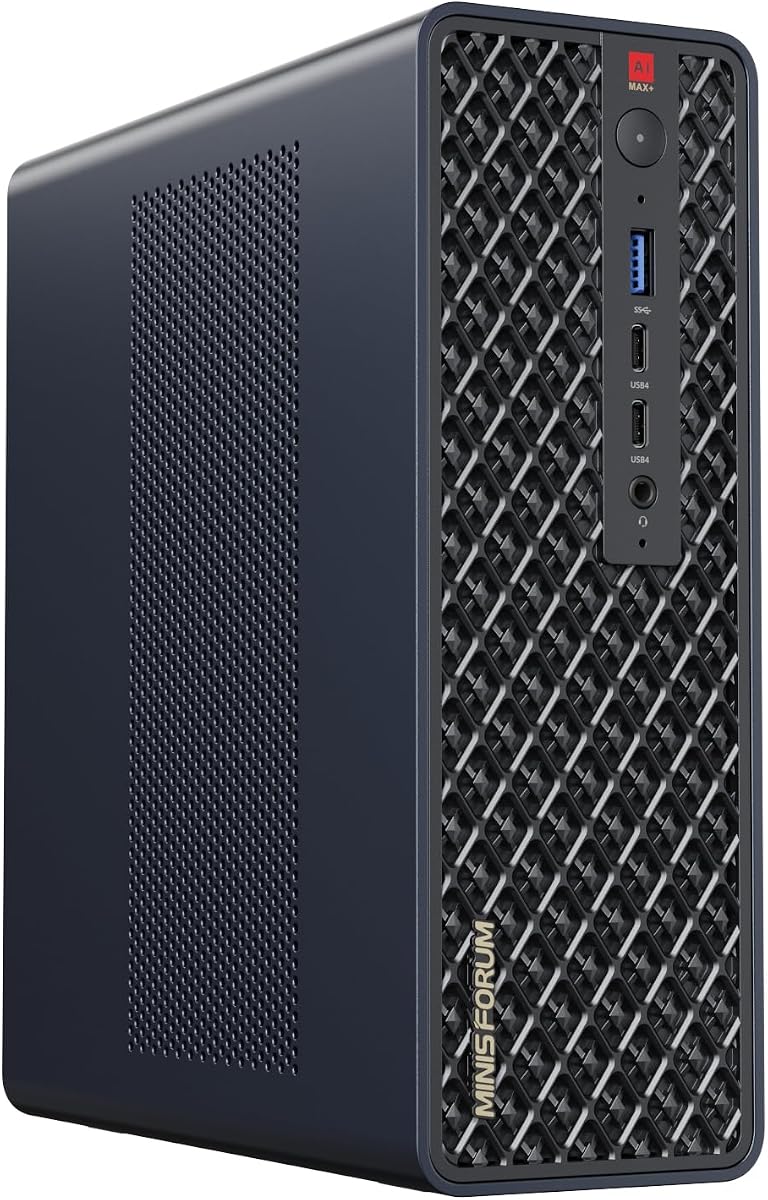
The MINISFORUM MS-S1 MAX Mini AI Workstation PC offers surprising power in a small frame. With AMD Ryzen AI Max+ 395 and 128GB unified LPDDR5x memory, it runs LLMs efficiently while consuming minimal power compared to larger systems.
We may earn a commission when you buy through this link, at no additional cost to you.
Its ability to cluster two units locally allows you to run 235B parameter models at high throughput. This makes it a great choice for developers needing scalable local testing without enterprise costs.
The system includes USB4 V2 (80Gbps), dual 10GbE LAN, and PCIe x16 expansion. While it lacks discrete GPUs, its NPU (50 TOPS) and CPU/GPU shared memory provide smooth performance for inference and light training tasks.
Pick this unit for budget-friendly, scalable local AI. It suits solo developers, studios, or light enterprise labs needing reliable, low-noise inference hardware.
The 128GB LPDDR5x unified memory pool ensures CPU and GPU share data seamlessly, removing traditional VRAM bottlenecks during inference.
Two MS-S1 MAX units can be cascaded to run massive models locally, offering distributed efficiency with low total power usage.
We may earn a commission when you buy through this link, at no additional cost to you.
The APC MES2X Dual GPU AI Workstation is built for professional workloads requiring maximum stability. With dual RTX PRO 6000 Blackwell GPUs each providing 96GB VRAM, it handles enterprise LLM inference and heavy visual workflows with ease.
We may earn a commission when you buy through this link, at no additional cost to you.
Powered by a Ryzen 9 9950X CPU and 256GB DDR5 RAM, it offers robust processing for data pipelines. The 8TB NVMe boot drive and 1600W PSU ensure your system boots quickly and maintains peak performance during long sessions.
Its 360mm liquid cooling and custom cable management reduce noise while ensuring heat dissipation. This setup is fully tested and comes with Windows 11 Pro preloaded, saving time on configuration.
Select this system if your work involves high-precision data science or CAD workflows. It delivers reliable, professional-grade power for teams needing minimal downtime.
The combined 192GB VRAM allows you to load multiple large models or run high-precision training without needing external server resources.
Custom cable management and stress testing ensure that the system remains stable under daily professional use.
We may earn a commission when you buy through this link, at no additional cost to you.
The NVIDIA DGX Spark 2 Pack brings supercomputer performance to the desktop. Using two GB10 Grace Blackwell chips, it delivers up to 1 petaFLOP of AI performance, enabling local fine-tuning and rapid innovation without cloud dependency.
We may earn a commission when you buy through this link, at no additional cost to you.
Each unit includes 128GB unified memory, allowing you to test massive models like 200B parameter at FP4 locally. This reduces time-to-solution for experiments while keeping costs predictable.
Its compact, energy-efficient design works well alongside cloud or data center resources. With seamless integration of NVIDIA AI software stack, developers can prototype faster and deploy anywhere.
This setup is ideal for enterprise developers needing secure, local AI prototyping. It offers a unique blend of power and accessibility for next-gen innovation.
With 256GB total unified memory across the dual pack, you can run and validate large models that typically require expensive data center hardware.
NVIDIA software integration simplifies development, letting you focus on model results rather than infrastructure setup.
We may earn a commission when you buy through this link, at no additional cost to you.
The ASUS Dual EPYC 9965 Server is a powerhouse for enterprise-scale LLM workloads. With dual 192-core CPUs and 2.3TB DDR5 ECC RAM, it processes massive datasets with extreme multi-threaded efficiency.
We may earn a commission when you buy through this link, at no additional cost to you.
It supports up to eight RTX PRO 6000 Blackwell GPUs, offering up to 768GB VRAM. This density is perfect for organizations that need to run multiple models or training jobs simultaneously.
Designed with 15 total NICs and hot-swap storage, it ensures high throughput and quick maintenance. The toolless chassis and ASUS Control Center simplify management even in large server rooms.
Choose this system for high-density clusters or data centers. It provides the reliability and scale needed for mission-critical AI tasks.
With 2.3TB RAM and 10 NVMe drives, this server eliminates data bottlenecks for real-time AI training and analytics.
Support for up to 10x 200GbE NICs ensures that data movement remains fast, keeping GPUs fed with data during training.
We may earn a commission when you buy through this link, at no additional cost to you.
The Cloud Ninjas Iron Bull AI Workstation is tailored for photogrammetry and survey workflows. Powered by Ryzen Threadripper 9970X and RTX 5090 GPU, it handles large terrain datasets with fast processing speeds.
We may earn a commission when you buy through this link, at no additional cost to you.
With 128GB ECC DDR5 RAM and 4TB NVMe SSD, it ensures data integrity and fast read/write performance. This is critical when working with large point clouds or GIS datasets.
Its 1600W PSU and 360mm liquid cooler keep the system running stably under heavy rendering tasks. The 10GbE LAN and Wi-Fi 7 ensure fast data transfer for fieldwork or studio syncing.
This workstation is ideal for surveyors and mapping teams. It offers specialized performance for heavy data capture and processing.
ECC memory protects your data during long processing times, preventing silent corruption in large-scale mapping projects.
10GbE and Wi-Fi 7 ensure you can transfer large map files quickly to other systems or cloud storage.
We may earn a commission when you buy through this link, at no additional cost to you.
The AMD EPYC 9965 Workstation PC delivers triple RTX PRO 6000 Blackwell GPUs for maximum VRAM capacity. With 768GB of DDR5 ECC RAM, it handles large-scale deep learning and CAD rendering without bottlenecks.
We may earn a commission when you buy through this link, at no additional cost to you.
Its 192-core CPU ensures that data ingestion and preprocessing keep pace with GPU compute. The 2x4TB Gen5 NVMe SSDs provide ultra-fast storage for loading massive training datasets.
Built by Empowered PC, this system undergoes rigorous stress-testing and includes a 3-Year Warranty. Its 2800W PSU ensures stable performance during continuous 24-7 operation.
Choose this if you need local training capacity for large models or complex simulations. It is ideal for labs needing triple GPU power in desktop form.
With 288GB total VRAM, you can load complex models or multiple models simultaneously for batch testing and validation.
Gen5 NVMe storage ensures you can ingest datasets as fast as your GPUs can process them, minimizing training idle time.
We may earn a commission when you buy through this link, at no additional cost to you.
The NVIDIA RTX PRO 6000 Max-Q workstation edition packs 96GB of GDDR7 ECC memory into a compact dual-slot design. It delivers 3,511 TOPS AI performance while capping power at 300W, enabling dense scaling without massive power requirements.
We may earn a commission when you buy through this link, at no additional cost to you.
This card fits in standard desktops, making it ideal for teams needing local VRAM without server builds. It supports zero-lag 8K video pipelines and real-time encoding for streaming studios.
Its thermal management ensures stable clocks even in multi-GPU setups. With native support for 8K content creation, it bridges high compute and visual workflows seamlessly.
Select this GPU if you need high VRAM in limited space. It works well for solo researchers or studios needing powerful local inference.
This 96GB card fits in standard workstation cases, removing the need for server-grade chassis to get enterprise VRAM.
300W power draw allows for dual-GPU scaling in consumer desktops without requiring a 1600W+ PSU.
We may earn a commission when you buy through this link, at no additional cost to you.
The MINISFORUM MS-S1 Max Mini Workstation offers powerful AI compute in a compact desktop. With 128GB unified LPDDR5 RAM and Ryzen AI Max+ 395, it handles LLMs and CAD workflows efficiently.
We may earn a commission when you buy through this link, at no additional cost to you.
Five 8K video outputs allow massive multitasking, ideal for traders or digital signage. Its 10GbE LAN and PCIe x16 slot ensure expandability despite its small size.
The cooling system maintains stable performance even at 130W continuous draw. With 128GB LPDDR5, it eliminates VRAM bottlenecks during video timelines and data visualization tasks.
Choose this mini PC if you want a small, powerful workstation. It is ideal for studios, small businesses, and light AI tasks.
Five 8K video outputs allow you to connect multiple displays for complex editing or data monitoring workflows.
128GB unified LPDDR5 allows smooth handling of 4K editing and large data processing tasks in a small chassis.
We may earn a commission when you buy through this link, at no additional cost to you.
Selecting the right Dual GPU AI Setup depends on your workload, budget, and physical space constraints. This guide outlines the key factors that impact performance, efficiency, and long-term reliability.
Memory capacity is the most critical factor for AI setups. Large language models require high VRAM to load weights without external storage. DDR5 or GDDR7 unified memory pools improve bandwidth and reduce bottlenecks.
Prioritize systems with at least 64GB VRAM per GPU or unified pools above 128GB for smooth LLM inference. ECC RAM adds reliability for large datasets.
Modern architectures like RTX 5090 or ARC Pro B60 offer higher TOPS for inference. More cores enable faster parallel tasks in batch processing or training loops.
Choose GPUs with newer architectures to support open-source models like Qwen or DeepSeek natively. Ensure your framework has drivers available.
High-core CPUs such as Ryzen Threadripper or EPYC handle preprocessing. Match CPU cores to GPU count to keep pipelines busy. Memory bandwidth directly impacts training speed.
Look for DDR5-5600+ RAM and fast storage. Bottlenecks here can slow GPU compute even if hardware is powerful.
Dual GPU systems consume significant power. Ensure your PSU is rated for peak loads with headroom. Liquid cooling or blower fans sustain performance.
Check case airflow. Thermal throttling reduces performance under load. A 1600W PSU ensures stable operation for high-end systems.
PCIe 5.0 x16 ensures full GPU bandwidth. Bifurcation support allows dual GPUs on consumer boards. USB4 and Ethernet enable fast data transfer.
Check M.2 or U.2 slots for storage expansion. Ensure your system supports future GPU upgrades.
Verify driver support for PyTorch or vLLM. NVIDIA has strong adoption; AMD ARC supports open-source tools. Enterprise cards include ECC and reliability features.
Choose systems with ISV certification for critical tasks. Ensure drivers are stable for your OS version.
Desktop workstations suit small teams. Rackmount servers suit large data centers. Mini PCs suit labs with limited space.
Ensure the unit fits your desk or rack. Consider noise levels for office environments.
Look for 1-3 year warranties with US-based support. Custom systems should include stress testing. Check replacement timelines.
Enterprise vendors offer longer support. Ensure the seller provides technical diagnostics.
Install the latest GPU drivers before loading models. Verify BIOS settings for PCIe bifurcation if needed. Ensure your OS recognizes both GPUs correctly.
Keep the system in a well-ventilated area. Clean dust filters monthly to prevent overheating. Monitor GPU temperatures during inference to avoid throttling.
Store models on fast NVMe drives. Use RAID for critical datasets. Back up training data to external drives or cloud storage for safety.
For most local LLMs, aim for at least 48GB total VRAM. Larger models like 70B or 200B require 96GB+. Unified memory pools help when VRAM is limited.
Dual GPU systems benefit from PCIe bifurcation. Server boards support it out of box. Consumer boards may require specific BIOS settings.
Windows 11 Pro for Workstations is widely compatible. Linux is preferred for training pipelines. Ensure NVIDIA/AMD drivers support your OS.
Most systems support additional GPUs if power and slots allow. Check motherboard lanes and PSU ratings before upgrading.
Unified pools allow flexible data sharing. CPU and GPU can access large datasets without copying. This reduces overhead and latency.
Liquid cooling is ideal for sustained loads. Blower fans also work for standard setups. Ensure airflow keeps components stable.
The WEELIAO MAXSUN Intel Arc Pro B60 48G, APC ES620, and MINISFORUM MS-S1 MAX offer top choices for different needs. From integrated cards to compact workstations, each delivers strong local AI capabilities.
Focus on memory capacity and compatibility with your models. High VRAM and newer architectures ensure future performance. Balance cooling and power for stability.
Verify current listings for pricing and availability. Specifications may change. Choose the setup that best matches your local inference or training goals.