
M-AUDIO Keystation 88 MK3
4.5Editor score
Plug-n-play USB connectivity
Slimline design fits any desk
Includes MPC Beats software
Discover the top 88 key weighted MIDI controllers for producers and pianists. Our guide compares features, key action, and software bundles to help you choose.
Choosing the right 88 key weighted MIDI controller is essential for musicians who demand a piano-like experience in their digital setup. These full-size keyboards offer the range and tactile feedback needed for expressive playing and professional music production across various genres.
We evaluated leading models based on key action quality, build durability, connectivity options, and software inclusion. Our comparison highlights how each controller integrates with popular DAWs and suits different workflows from home studios to live performance stages.
Each pick showcases unique strengths like hammer action, semi-weighted keys, or deep DAW integration. Prices fluctuate frequently so check current listings before purchasing. This guide ensures you find a controller that matches your skill level and creative goals effectively.
4.5Editor score

4.6Editor score

4.3Editor score
This side-by-side comparison details the core specifications and features of the top ranked controllers. We examine key types, connectivity, included software, and control surfaces to help you identify the best match for your studio environment.



The Novation Launchkey 88 [MK3] stands out as a top-tier option for producers seeking a balance between playability and control. With a rating of 4.6 stars it delivers premium semi-weighted keys and seamless integration across leading digital audio workstations.
We may earn a commission when you buy through this link, at no additional cost to you.
Its standout features include deep DAW integration that allows immediate access to essential controls without complex mapping. The powerful arpeggiator with Strum Mode and Creative Scale modes unlock new melodic possibilities for songwriters and beat makers alike.
While it lacks fully weighted hammer action which some pianists prefer the semi-weighted keys offer a responsive feel suitable for synth lines and melodic composition. The only real trade-off is the reliance on software mapping for some users who prefer hardware memorization.
This controller is ideal for electronic music producers and home studio owners who prioritize workflow efficiency over acoustic piano simulation. We highly recommend it for those ready to expand their creative toolkit with intuitive hardware control and robust software support.
Deep integration with major DAWs provides immediate access to transport and track controls directly from the keyboard.
Scale and chord modes let you trigger complex harmonies with single finger presses enhancing productivity during writing sessions.
We may earn a commission when you buy through this link, at no additional cost to you.
The M-AUDIO Keystation 88 MK3 offers an accessible entry point for musicians needing a full-range keyboard without breaking the bank. With a solid 4.5 rating it focuses on core functionality and immediate plug-n-play usability across Mac and PC systems.
We may earn a commission when you buy through this link, at no additional cost to you.
Its key strengths include effortless USB connectivity that requires no drivers or external power supply making it perfect for mobile setups. The slimline design fits comfortably on any desk ensuring it does not dominate limited studio space while delivering essential transport controls.
On the downside the controller lacks advanced features like assignable knobs or pads which limits real-time parameter tweaking compared to more expensive models. This simplicity is acceptable for beginners who primarily need a reliable interface for triggering virtual instruments.
We recommend this model for students and hobbyists seeking a straightforward tool for recording ideas and learning composition. It remains one of the best budget options available for anyone prioritizing essential MIDI functionality over extensive tactile controls.
Plug-n-play connectivity ensures you start making music instantly without spending time on technical configuration or drivers.
The slim design integrates perfectly into any studio setup acting as a functional center for your music production workflow.
We may earn a commission when you buy through this link, at no additional cost to you.
Arturia's KeyLab 88 mk3 delivers a premium experience with fully weighted hammer-action keys designed to mimic the response of an acoustic piano. Its 4.3 rating reflects strong performance and build quality ideal for serious musicians demanding tactile precision and expressive dynamics.
We may earn a commission when you buy through this link, at no additional cost to you.
This controller excels with 12 pressure-sensitive performance pads that offer nuanced control for drum triggering and sample playback. The USB-C power connection provides stable operation while the included sheet music stand enhances usability during composition sessions.
The high cost may be prohibitive for entry-level users but the investment pays off in durability and realistic key action. While requiring USB power can limit portability slightly the performance benefits justify the expense for professional home studio environments.
We suggest this model for pianists and composers who prioritize key feel above all else. It remains a top choice for those seeking a comprehensive MIDI interface that supports both performance and detailed production work effectively.
Hammer-action keys provide realistic resistance and rebound allowing for expressive dynamics similar to an acoustic piano.
Twelve performance pads react to pressure offering creative control for percussion and sampled sounds during live play.
We may earn a commission when you buy through this link, at no additional cost to you.
The white variant of the KeyLab 88 mk3 offers the same premium performance as the black model while providing a striking visual option for stylish studios. It carries a rating of 3.8 due to aesthetic preferences and minor build variations but remains functionally identical.
We may earn a commission when you buy through this link, at no additional cost to you.
This controller features fully weighted hammer-action keys and 12 pressure-sensitive pads ensuring the same expressive capabilities as its darker counterpart. The white finish stands out visually making it a centerpiece for modern desktop setups and professional environments.
Potential buyers should note that lighter colors may show dust or fingerprints more readily during heavy use which requires more frequent cleaning. However for those prioritizing visual design without sacrificing performance this model delivers robust functionality in a unique package.
We recommend this version for designers and artists who value equipment aesthetics as much as utility. It serves as an excellent choice for those wanting a premium keyboard that complements a clean and contemporary studio workspace effectively.
The white finish offers a sleek modern look that enhances the visual appeal of any contemporary studio environment.
Despite the color change all technical specifications and performance features remain exactly the same as the black version.
We may earn a commission when you buy through this link, at no additional cost to you.
The Studiologic SL88 MK2 is recognized for its responsive weighted keybed and practical onboard display that simplifies navigation during performance. With a rating of 4.5 it appeals to players who value tactile feedback and straightforward control without excessive software dependencies.
We may earn a commission when you buy through this link, at no additional cost to you.
Key strengths include 7 encoders that allow quick parameter changes and compatibility with the Numa Player for expanded sound shaping capabilities. The build quality ensures durability while the design focuses on function over flashy aesthetics suitable for stage and studio use.
One limitation is that software support may not be as robust as other brands leading to more manual mapping for some digital audio workstations. The visual design is functional but lacks modern features like backlit controls found in newer competitive models.
We recommend this controller for pianists seeking a straightforward interface with strong mechanical feedback. It remains a solid choice for users who prefer hardware-based control and reliable performance over extensive software integration options.
The display provides immediate feedback on settings and parameters reducing the need to check the computer screen constantly.
Seven encoders offer flexible control over sound parameters allowing real-time adjustments during live performance or mixing.
We may earn a commission when you buy through this link, at no additional cost to you.
The YAMAHA P71 is primarily a digital piano but functions well as a MIDI controller for those prioritizing authentic key action and sound quality. It holds a strong 4.7 rating for its ability to deliver a natural playing experience with minimal setup required.
We may earn a commission when you buy through this link, at no additional cost to you.
Key benefits include the weighted action that replicates an acoustic piano and 10 unique voices including a rich grand piano voice. The package comes with a sustain pedal and power supply making it a complete solution for beginners needing immediate playability.
While it offers great sound and touch it lacks dedicated MIDI controls like faders or knobs which limits its utility for detailed production work. Users must rely on software controls for mixing rather than tactile hardware feedback during session recording.
We recommend this model for piano students and performers who want a high-quality playing experience without complex MIDI features. It serves as an ideal starting point for musicians focused on performance and composition over sound design manipulation.
The weighted action keys provide true expression and dynamic performance replicating the feel of an acoustic piano.
The included sustain pedal and power supply allow immediate use right out of the box without extra purchases.
We may earn a commission when you buy through this link, at no additional cost to you.
The KeyLab Essential mk3 offers a streamlined entry into full-size MIDI control with a hybrid synth-piano feel and robust software inclusion. Rated at 4.4 it balances affordability with professional features like creative modes and a bright LCD for real-time feedback.
We may earn a commission when you buy through this link, at no additional cost to you.
This controller features 2000 analog lab presets and new creative features like Scale Mode and Chord Mode that simplify composition for beginners. The expanded software package includes subscriptions to Loopcloud and Melodics adding extra value for those building a studio.
While the key action is not fully weighted it provides a comfortable experience for electronic music creation. Some users may find the initial calibration and setup requires time but the overall package offers substantial value for the price point.
We recommend this for beginners seeking a full-range controller with extensive creative tools. It serves as an excellent upgrade for those outgrowing smaller keyboards while maintaining a manageable price for student and home studio budgets.
Scale and Chord modes make songwriting intuitive allowing even beginners to create complex harmonies easily.
Includes Analog Lab Pro and subscriptions to major platforms delivering significant value and sound variety for users.
We may earn a commission when you buy through this link, at no additional cost to you.
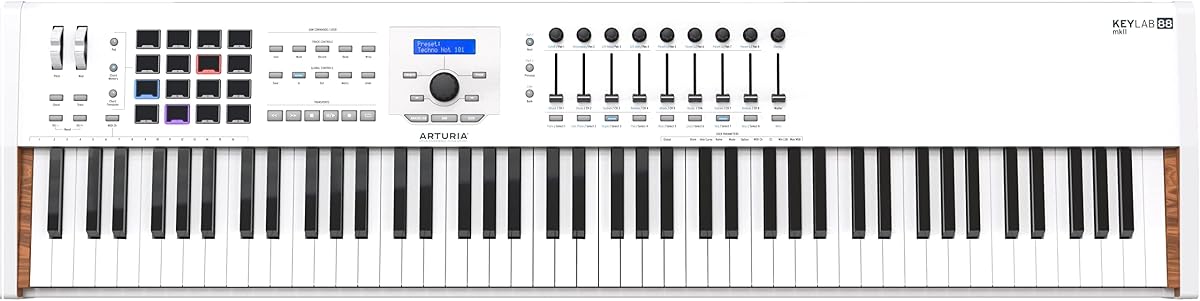
The Arturia KeyLab 88 MkII stands out with its comprehensive control surface featuring 9 faders and knobs for deep integration with DAWs. With a rating of 4.6 it delivers a high-quality keybed and extensive software support for professional production workflows.
We may earn a commission when you buy through this link, at no additional cost to you.
Its standout qualities include the Fatar TP/100LR keybed which offers excellent aftertouch and velocity sensitivity for expressive performances. The included Analog Lab V provides a massive library of sounds enhancing the value proposition for producers needing versatile synthesis.
One trade-off is the large physical footprint which may require significant desk space. The price is higher than entry-level models but the robust build and control depth justify the investment for serious studio environments.
We recommend this model for producers who need extensive mixing and sound control at their fingertips. It remains a top choice for those seeking a balanced combination of piano feel and comprehensive studio command.
Nine faders and knobs allow detailed control over mix parameters and effects during live recording sessions.
The Fatar TP/100LR keybed ensures consistent response and durability for professional playing demands.
We may earn a commission when you buy through this link, at no additional cost to you.
The Roland A-88MKII is built for longevity with wood and premium materials ensuring reliable performance over years of use. With a rating of 3.8 it appeals to professional musicians seeking a rugged controller with advanced connectivity features.
We may earn a commission when you buy through this link, at no additional cost to you.
It features the PHA-4 keyboard action and support for MIDI 2.0 making it future-ready for evolving music technology. The shallow depth design fits modern studios while USB-C bus power eliminates the need for extra adapters or cables.
However the controller is heavier and may require more careful transport than lighter alternatives. Setup can be complex due to the number of customization options available in the control application.
We recommend this for touring professionals and producers requiring a durable and future-proof device. It remains a strong option for those who prioritize build quality and connectivity standards over lightweight portability.
Wood and premium materials ensure the unit withstands heavy professional use over many years.
Support for MIDI 2.0 ensures compatibility with future software and hardware standards for seamless integration.
We may earn a commission when you buy through this link, at no additional cost to you.
The M-AUDIO Hammer 88 Pro brings native integration with Native Instruments products offering seamless control for users invested in that ecosystem. With a rating of 3.9 it delivers a full weighted action and extensive control surface for detailed production tasks.
We may earn a commission when you buy through this link, at no additional cost to you.
Key strengths include NKS integration allowing direct preset browsing and control of software synthesizers. The 16 RGB backlit pads and 9 assignable faders provide tactile feedback for drum production and mixing workflow optimization.
Some users may find the menu system complex initially and the unit is heavy which impacts portability. These trade-offs are acceptable for those prioritizing deep software integration and robust hardware control over light transport.
We recommend this for Native Instruments users needing deep control over their software libraries. It remains a strong choice for producers focused on beat-making and detailed sound design within a comprehensive hardware interface.
NKS support lets you browse and control Native Instruments presets directly from the keyboard.
Multiple faders knobs and buttons offer tactile control over virtual instruments and DAW functions.
We may earn a commission when you buy through this link, at no additional cost to you.
Selecting the right controller depends on your specific workflow needs and preferred key action feel. This guide outlines the primary factors to consider when evaluating full-size MIDI keyboards for your studio.
The most critical factor is the key action which determines how the keyboard feels under your fingers. Fully weighted hammer-action keys mimic acoustic pianos with internal weights and hammers providing realistic resistance. Semi-weighted keys use springs for a lighter feel suitable for synth playing but lacking dynamic depth.
Choose fully weighted if you prioritize piano expression and heavy use of chords. Semi-weighted options are better for electronic music producers who need speed and lighter touch.
Modern controllers offer USB and MIDI inputs or outputs. Ensure the controller supports USB-C or USB-A depending on your system's ports. MIDI outputs allow connection to external synthesizers and hardware gear without relying solely on computer integration.
Look for USB-C for modern data transfer speeds and bus power compatibility. MIDI outputs are essential if you use standalone gear alongside your software.
Deep integration with your Digital Audio Workstation can significantly streamline production. Look for controllers that ship with custom scripts for software like Ableton Live Logic Pro X or FL Studio.
Custom mappings save time by assigning transport controls to hardware buttons. Verify compatibility with your preferred DAW before purchasing to ensure seamless operation.
The variety of knobs faders and pads impacts how you manipulate sound during recording. Faders allow volume control while knobs adjust effect parameters. Pads serve for triggering clips or drums.
Prioritize controllers with enough assignable controls to match your workflow. More physical knobs reduce reliance on mouse clicks and mouse scrolling.
Many controllers include virtual instruments or DAW editions like MPC Beats or Ableton Live Lite. These bundles add significant value and provide immediate tools for production.
Check the software titles included to see if they meet your needs. Some bundles offer full versions while others provide limited feature sets.
Consider the physical weight and dimensions if you plan to move the controller between locations. A lightweight plastic shell may be easier to transport than a unit built with wood or heavy metal.
Durable construction ensures longevity in professional environments. Weigh the need for transport against the build quality requirements of your setup.
Most modern keyboards run on bus power from the USB cable but some require external power bricks for stability. Bus power simplifies setup by reducing cable clutter.
Verify power requirements to ensure you have the correct cables and outlets. External power can provide more consistent performance in large setups.
Prices range significantly based on materials and features. Basic semi-weighted options are more affordable while fully weighted premium units demand higher investment.
Determine a realistic budget based on your skill level. Higher cost does not always guarantee better performance if you do not need the advanced features.
To get started connect the controller to your computer using the provided USB cable. Ensure your DAW is open and select the device in the MIDI preferences menu to enable input.
Use the built-in software included with the controller to download drivers or maps specific to your system. This ensures all knobs and faders function correctly during production sessions.
Maintain your controller by keeping it covered when not in use to prevent dust accumulation on keys and pads. Avoid direct sunlight or extreme temperatures which can warp plastic and wood components over time.
Most modern models draw power from the USB connection but some require an external brick for stability. Check the product specifications to confirm if bus power is sufficient for your setup.
Keyboards from brands like Novation and Arturia offer deep integration for Ableton Live Logic Pro and FL Studio. Most standard DAWs work generally but custom scripts optimize performance significantly.
Weighted keys use internal weights to mimic an acoustic piano feel while semi-weighted keys use springs for a lighter touch. Choose based on your need for dynamic expression versus speed.
Generally these devices require a computer to function as MIDI controllers. Some models offer USB MIDI output to connect to hardware synthesizers but they still rely on a source for full functionality.
Most require an Apple Camera Adapter to connect via USB-C or Lightning ports. Ensure the controller is class compliant to work without additional drivers on iOS devices.
Yes most packages include a suite of virtual instruments such as MPC Beats or Analog Lab V. These provide immediate sound resources for composition without additional purchases.
Selecting a 88 key weighted MIDI controller requires balancing key feel with control surface features. Whether you choose the premium Arturia KeyLab 88 mk3 or the affordable M-AUDIO Keystation 88 MK3 each option offers distinct advantages for different workflows.
Focus on what matters most to your production style whether that is deep DAW integration or authentic piano feel. The right controller should enhance your creative process rather than complicate it with unnecessary complexity.
Always verify current prices and software bundles before purchasing as offerings may change frequently. Investing in a controller that aligns with your long-term goals will provide the best return on investment.